


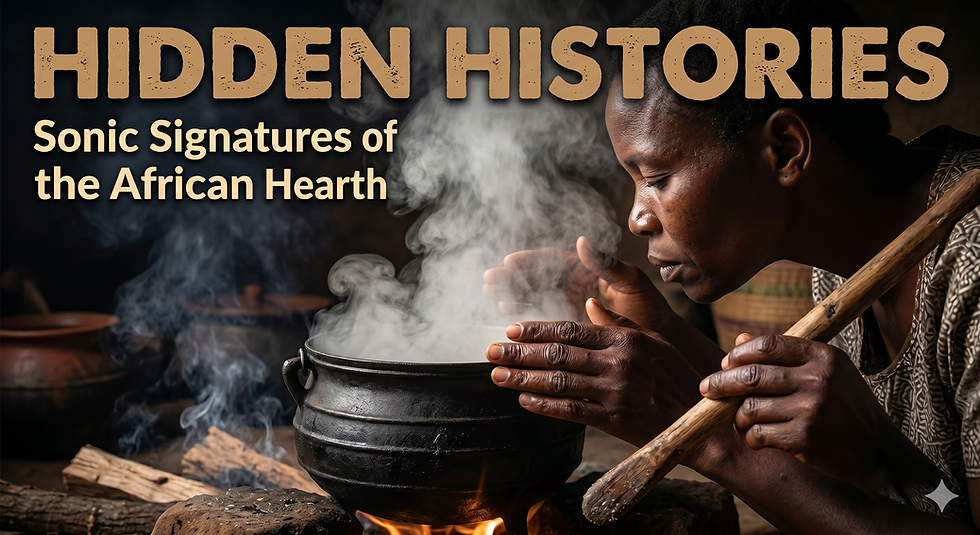
HIDDEN HISTORIES: The Language of the Hearth

We often speak of our culinary traditions as if they were museum pieces: static, dusty, and meant only to be looked at through a glass display. But our food is a living, breathing technology, and the language we use to cook it is the code that keeps it alive.
When we try to describe our cooking in English, we are forced to use generic labels that make no sense in our kitchens. We use words like "boiling" or "simmering" because that is what the dictionary gives us. But these words are hollow. They are scientific observations that describe what a pot is doing, rather than the intimate, precise, and deeply physical instructions passed down through our tongues for centuries.
The Mini-Glossary of the Hearth
To call Kukwata a "boil" is to ignore the volcanic, rhythmic pop that tells a cook exactly when the starch is ready to be handled. To call Kushinyira a "simmer" is to miss the heavy, rhythmic sigh of trapped steam forcing its way out of a solid liquid, signaling that the process has reached its peak. And Kuvava a word that dances between bitter, sour, and the searing heat of chili reminds us that flavor is not a static measurement, but a complex sensation.
When we let these words fade, we don’t just lose vocabulary; we lose the ability to teach the next generation how to cook with soul.
The Grammar of Life and Pot
The true power of our language lies in its refusal to separate the act of cooking from the act of living. In English, a word is often confined to a single definition. In our language, a word is a journey that starts in the pot and ends in the soul of the community.
Kuibva: In the kitchen, this is the simple joy of a fruit reaching sweetness or a meal finally being cooked and ready to eat. Yet, when we apply it to a person, it describes someone who has moved beyond youthful impulsivity to become deeply mature, wise, and experienced. It can even signal that a secret plan is no longer just an idea; it is "ripe" and ready to be executed.
Kuomesa: We use this to describe the culinary technique of dehydrating meat or vegetables to preserve them. But in the harsher reality of life, it describes the act of making things extremely difficult for someone, or the heavy weight of a severe financial squeeze zvinhu zvakaoma where life itself feels like it is being stripped of its moisture and comfort.
Kubika: While the world sees this only as the act of boiling or preparing food, we know it carries a sharper edge. To "cook" is also to concoct a lie, to plot a complex conspiracy, or to masterfully scheme behind closed doors. It acknowledges that, like a well-prepared meal, a plan requires patience, heat, and careful layering to reach completion.
A Call to Resistance
When we translate these words into English, we lose this fluidity. We lose the realization that the same care we take to ensure a meal is kuibva is the same care we should take in cultivating our own character. We lose the warning that a life can be kuomesa just as surely as a piece of sun-dried meat.
History books and mainstream culinary guides often miss these complex methods not because our systems lack rigor, but because written words struggle to capture a sound, a feeling, or a philosophy. By actively using, teaching, and writing these terms, we are practicing a quiet form of resistance. We are asserting that our palate has its own grammar, its own history, and its own deep, untranslatable truth.
The next time you are in the kitchen, don't just "stir" kumona. Don't just "cook" listen for the Kupwata and the Kushinyira. Keep the language alive, because when the language dies, the memory of the meal, and the wisdom of the hearth, dies with it.


Comments